Everything You Need to Know About Chord Progressions
Songwriter Harlan Howard once famously claimed that country music was little more than "three chords and the truth." That's an oversimplification of music theory, but it holds more truth than you might expect, especially when you look at modern popular music.
There are countless chord combinations that can be used to build intricate songs, but the vast majority of rock, country, and pop songs lean on the same handful of patterns. These patterns are as useful as they are ubiquitous. Understanding them is one of the fastest ways to level up as a songwriter or guitarist.
What Is a Chord Progression?
A chord progression is, put simply, a series of chords that work well together, creating a sense of "return" or "completion" as they move from one to the next. Virtually every song played on the guitar uses some form of chord progression, though it's technically possible to build a hit song around almost a single chord, as Aretha Franklin did with "Chain of Fools."
Most chords are built from a triad: a root note plus its third and fifth. A C chord, for example, is made up of the notes C, E, and G. When you stack chords into a progression, you typically label them with Roman numerals based on their position in the key, with capital numerals for major chords and lowercase for minor.
The I, IV, V Progression
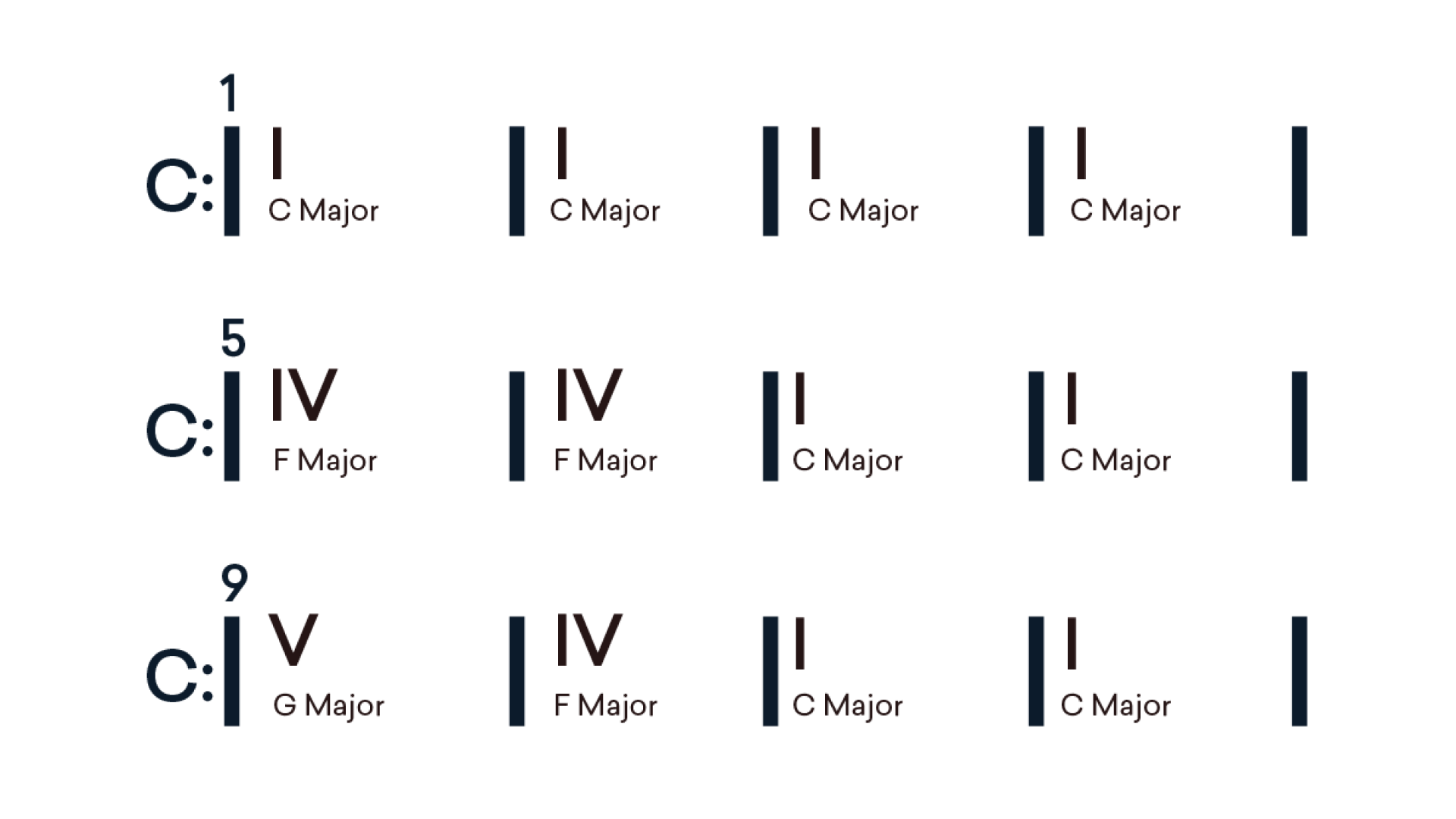
The most common chord progression in popular music is built from the I, IV, and V chords. In the key of A, that would be A major (I), D major (IV), and E major (V). This structure holds in any key: C major (I), F major (IV), and G major (V) is likely the single most common chord progression on guitar, closely followed by G (I), C (IV), and D (V).
A close cousin of this progression is I, IV, vi, V, where the vi chord is played as a minor rather than a major, adding a slightly wistful or haunting quality to the sound. In the key of G, this would give you G, C, Em, and D—another extremely common progression, and one that, like all progressions, can be rearranged in whatever order a songwriter wants.
Starting Somewhere Other Than "I"
Not every progression opens on the I chord or includes a vi. Maroon 5's hit "Sunday Morning" is a good example. The song opens on the second chord of its progression, played as a minor (Dm), before moving to the V chord (G major) and finally resolving on the I chord (C major). This ii–V–I progression is simple but effective. Because the I chord is delayed rather than stated up front, the listener's ear anticipates its arrival, and that sense of delayed resolution is part of what gives the song its wistful, "haunting" charm.
This same ii–V–I sequence can be expanded by adding a vi chord, turning it into Dm, G, C, Am. You could even experiment with slipping that Am into "Sunday Morning" itself—say, after the C at the end of each line—and it would still sound musically coherent, since Am (vi) is part of the C major chord family, even though it departs from the original recording.
The Circle Progression
Shift the starting point of that same four-chord sequence, without changing the order, and you get vi, ii, V, I, commonly known as the circle progression, a nod to the circle of fifths that many musicians use as a harmonic reference. This progression has powered guitar-driven hits for decades, including Weezer's "Island in the Sun."
Pachelbel's Enduring Influence
Chord progressions aren't confined to the guitar, or even to popular music. One of the most famous progressions of all comes from the Baroque period, by way of composer Johann Pachelbel and his best-known work, "Canon in D." That progression—I, V, vi, iii, IV, I, IV, V—is proof that even centuries after the foundations of modern music theory were laid, truly original chord sequences are hard to come by.
Pachelbel's progression has shaped an enormous swath of modern pop, often without listeners realizing it. Blues Traveler frontman and harmonica player John Popper poked fun at its ubiquity and at the formulaic nature of pop songwriting in the band's song "Hook," which is built directly on Pachelbel's eight-chord sequence. Ironically, the joke seems to have gone over the heads of many listeners. "Hook" became one of Blues Traveler's biggest hits, proving Howard's old adage all over again. All a musician really needs, it turns out, is a bit of truth and a handful of chords—in this case, eight of them.