Keep on Rockin’ in a Free Country: A Look Back at the American Bicentennial Concerts
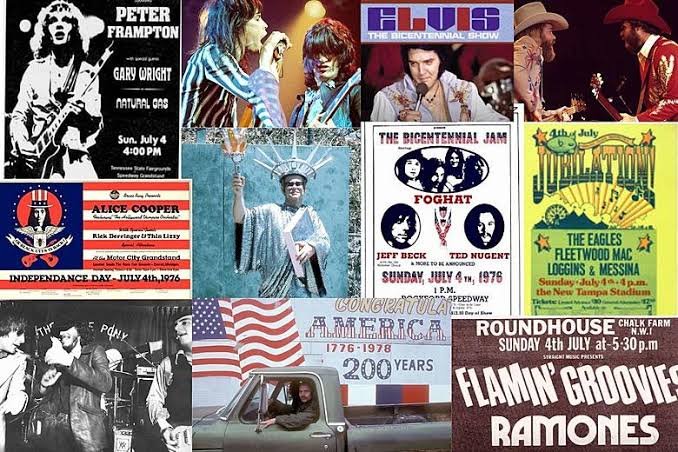
As the United States celebrated its 250th anniversary this summer, concerts were held across the country to mark the occasion. While the Freedom 250 Concert in Washington, DC, suffered from artist cancelations, America’s Block Party, organized by the nonpartisan America250 organization, fared better. From New York to Los Angeles and several locales in between, the concert series brought together artists from a range of genres to celebrate the country’s independence.
The last time the United States celebrated a milestone birthday, big-name performers similarly came out to mark the occasion. For America’s bicentennial in 1976, states, cities, and towns around the country were empowered by President Gerald Ford to put together concerts best suited to their regions. The result was a plethora of shows featuring some of music’s biggest names.
While some of these concerts were held around, but not on the July 4 holiday, many artists came out on Independence Day to make sure the United States began its third century with a bang. From Elvis to Elton John, let’s look back at some of the most memorable bicentennial performances that happened on July 4, 1976.
Elvis Presley
Elvis was nearly a year away from dying at the too-young age of 42 when he took the stage at the Mabee Centre in Tulsa, Oklahoma. Despite being plagued by health problems, he turned in a special bicentennial-themed performance that was recorded and later released as a live album. Drawing on his deep catalog of hits and mixing in covers by the likes of Chuck Berry, Gordon Lightfoot, and Ray Charles, Elvis reminded spectators of why he remained such a seminal figure in American music.
Elton John
It may have been strange to some that a Brit would headline an Independence Day concert, but that’s exactly what happened when Elton John performed in front of 60,000 cheering fans in Foxborough, Massachusetts. Recognizing the Americanness of the celebration, Elton John played to the crowd by donning various US-themed outfits, including a Statue of Liberty costume.
One of the biggest pop stars in the world at the time, Elton John ran through his slew of hits, including “Bennie and the Jets,” “Your Song,” and “Goodbye Yellow Brick Road,” as well as the soon-to-be-released “Philadelphia Freedom.” Traffic’s former guitarist Dave Mason opened the show and remembered it wistfully years later, writing on social media in 2021, “How fondly I remember the nation’s Bicentennial, July 4th, 1976. I spent that magnificent landmark in front of 60,000, performing with Elton John in concert.”
Bruce Springsteen
Bruce Springsteen had appeared on the covers of both Time and Newsweek and was touring behind the massively successful Born to Run, but rather than spending the bicentennial playing another stadium show, he returned to his roots at the Stone Pony, one of the Jersey Shore clubs where he had started out. The tiny venue gave Springsteen’s fans a rare opportunity to see the rising star in an intimate setting. Springsteen played to the occasion, inviting fellow hometown heroes Southside Johnny & the Asbury Jukes to join him on stage, including for a cover of Eddie Floyd’s “Knock on Wood.”
The Eagles/Fleetwood Mac/Loggins and Messina
At the time of the bicentennial, the Eagles were touring behind the smash hit compilation Their Greatest Hits (1971-1975). Meanwhile, Fleetwood Mac had released their self-titled White Album the year before. Amazingly, with the former’s Hotel California only months away and the latter’s Rumours coming up the following year, both bands would soon soar to even greater heights.
Joined by Loggins and Messina in what would be one of the duo’s final performances, the Eagles and Fleetwood Mac came together for a collaborative concert in front of 37,000 fans at Tampa Stadium. Fans of soft rock couldn’t have asked for a better bill.
ZZ Top/Blue Öyster Cult/Lynyrd Skynyrd
ZZ Top headlined this Southern rock summit at the Liberty Bowl in Memphis, Tennessee. In the midst of a World Wide Texas Tour, which saw the trio perform on stage with actual livestock, ZZ Top was joined by the Florida-based Lynyrd Skynyrd. Also on the bill were the Outlaws, another Florida group whose presence served to enhance the concert’s Southern rock pedigree. The New York–based Blue Öyster Cult were the outlier but earned second billing thanks to the runaway hit “(Don’t Fear) The Reaper,” which had been released earlier in the year. It was a loud, sweaty night in the South.
Foghat/Derringer/Ted Nugent
To the north in Illinois, another set of blisteringly loud acts descended on Rockford Speedway for a mini-festival dubbed the Bicentennial Jam. As in Massachusetts, a British act, Foghat, headlined the festivities, but the United States was well represented by Derringer (led by Rick Derringer, the man behind “Rock and Roll, Hoochie Koo”) and Ted Nugent. Head East and Mahogany Rush served as openers, the latter of whom turned in a memorable, guitar-centric version of the “The Star-Spangled Banner.”