A Look at How Electric Guitars Create Sound
The electric guitar has become one of the most important instruments in modern Western music, serving as both the foundation—rhythm—and decorative element—riffs and solos—in rock, pop, country, and a variety of other genres. From its introduction in the early 1930s and central role in blues bands in the middle of the century to the development of rock in the 1950s and 1960s and the development of various subgenres such as punk, metal, and indie over the past 50 years, the electric guitar has become virtually ubiquitous. The instrument has produced some of the most recognizable pieces of music in the 20th and 21st centuries and supported the reputation of legendary artists such as Jimi Hendrix, Eric Clapton, and Stevie Ray Vaughn.
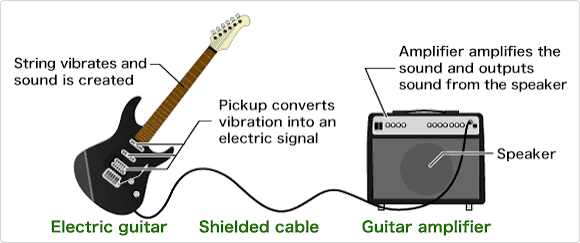
But how exactly does the electric guitar work? While the mechanism used to create sound in acoustic guitars is pretty self-evident (the hollow box amplifies notes created by the vibration of plucked and strummed strings that are manipulated through finger pressure on the frets), the electric guitar lacks the hollow body necessary to amplify the string vibrations. While a muted, relatively quiet sound can be heard by the musician and anyone sitting very close to them while playing the instrument while it is unplugged, amplification is necessary to make the sound resonate enough for large crowds to hear it. This is accomplished through a simple, but ingenious process that involves electromagnets.
The Parts of An Electric Guitar
There are many different styles of electric guitars, ranging from the aesthetically pleasing curves of the Les Paul to the sharp angles of the Strat. But generally speaking, most electric guitars have the same main parts. They include the body, which is typically made of a solid hardwood, such as ash, mahogany, or alder—all of which have great sustain and limit feedback. That being said, some electric guitars are hollow body or semi-hollow.
The neck is attached to the body, and is a long, narrow strip of wood—often mahogany or maple—with metal frets installed along it. These frets allow the six strings to produce different notes when they are pressed at different points.
Guitar Strings Vary in Thickness
The strings on guitars are typically made of steel or nickel-plated steel. They vary in thickness, with the top strings—the lowest—being thickest and the bottom—highest—being thinnest. The strings are elevated from the neck by the bridge, which also keeps them the correct distance apart.
The body has an output jack installed in it that accepts a cable. This sends electrical signals out of the guitar to an amplifier, which is essentially a speaker that receives sound signals directly from the guitar. It also has a number of control knobs, which allow the guitarist to adjust things such as volume, tone, and which pickups are actively accepting sound.
Finally, the pickups are arguably what differentiate electric guitars from acoustic guitars the most. Rather than featuring a hollow body that amplifies the sound produced by the strings, electric guitars depend on electromagnetic induction, which was discovered by Michael Faraday in the 1800s. Pickups are generally made out of one or more magnets wrapped with thousands of windings of copper wire. The magnets created a magnetic field that the vibration of the guitar strings interfere with. This creates a small AC current in the copper wire wrapped around the magnets, which just happens to reflect the amplitude and frequency of the guitar string that has been plucked or strummed (that is to say, the note and volume created by the vibration of the strings is communicated through the pickup and translated from mechanical energy into electrical energy.
The Two Main Types of Pickups
There are two main types of pickups—single-coil and humbuckers. As the name suggests, single-coil pickups have a single magnet or set of magnets per string. They have a clear, ringing tone, but tend to also pick up interference, producing a sound that many music fans will recognize from early electric guitarists. On the other hand, the humbucker has two coils wired in opposite directions (producing opposite polarities), which cancels out interference and creates a thicker, warmer sound.
The electrical signals created by the pickup are transmitted through internal wiring in the guitar to the output jack. The guitar cable then transmits these signals to an amplifier, which boosts the signals through the use of a preamp and power amp. The signals move through the amplifier to its speakers, which convert them back into sound waves and broadcast them to audiences. Amps can be adjusted to shape the tone by varying elements such as bass, treble, mid, presence, distortion, reverb, and tremolo. Finally, some guitarists use pedal boards—outfitted with a series of effect pedals—that can further shape the sound being emitted through the amplifiers’ speakers for audiences to enjoy.