New Bruce Springsteen Museum Celebrates American Music
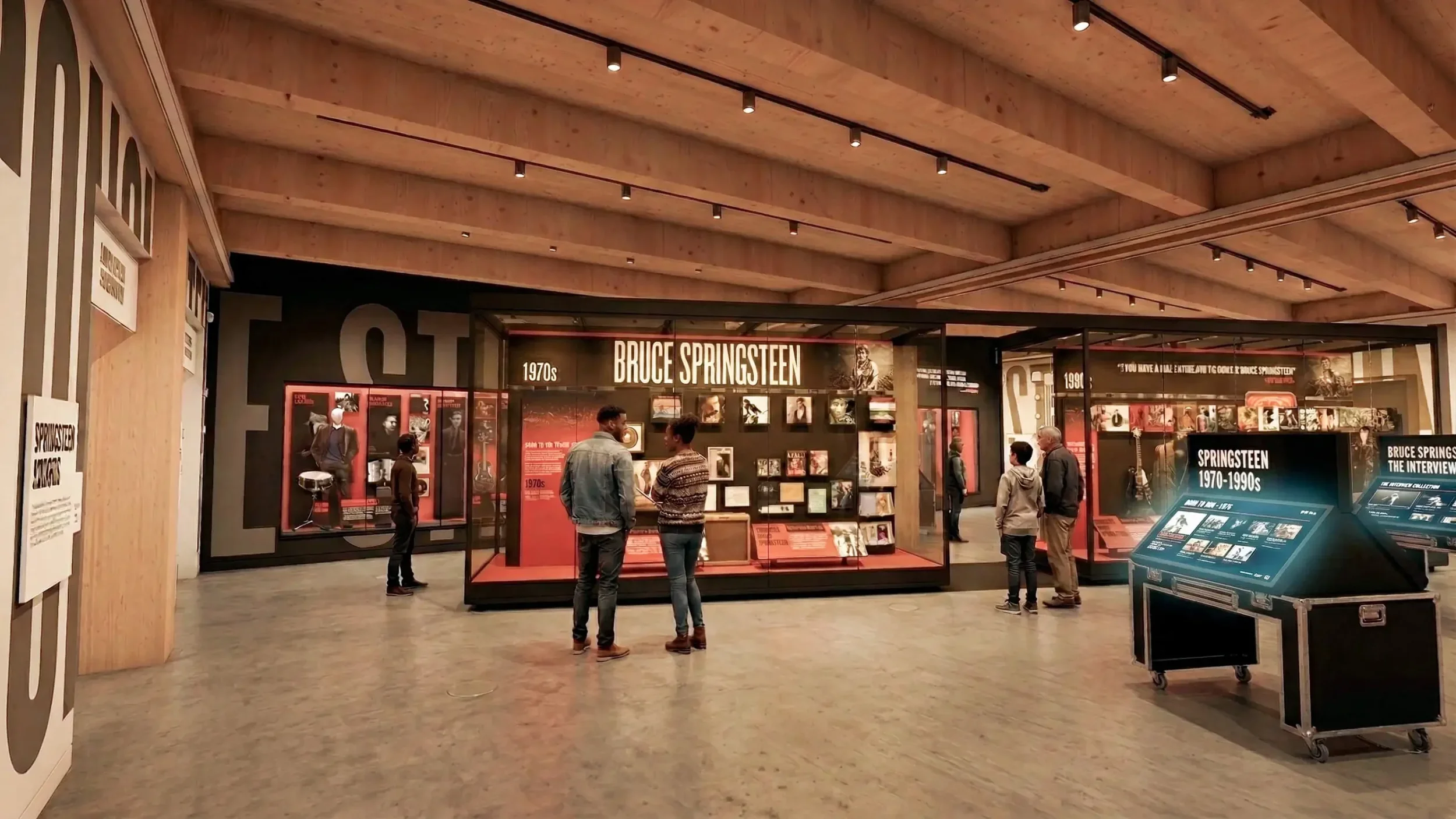
A new museum is dedicated to preserving Bruce Springsteen’s legacy for generations to come. In June, the Bruce Springsteen Center for American Music opened at Monmouth University in New Jersey. Spanning 32,000 square feet, the institution highlights Springsteen’s storied career and explores the broader traditions of American music.
“We are honored to host the Bruce Springsteen Center for American Music on our beautiful campus here at the Jersey Shore,” said Patrick F. Leahy, president of Monmouth University. “This center reminds us that music has always been one of the most powerful teachers in American life.”
Educating visitors on the history of American music
Consisting of two floors, the museum indeed aims to educate visitors, with the exhibits on its first floor organized by gender, political messaging, genre, and other themes in an effort to teach visitors about the vast history of American music. Among the artifacts on display are Johnny Cash’s guitar, George Clinton’s cape, Lady Gaga’s costume, and Frank Sinatra’s tuxedo. Beastie Boys merch sits near Woody Guthrie and Joni Mitchell lyrics. Ella Fitzgerald’s concert dress is in the same case with the brass instruments of jazz greats Louis Armstrong, John Coltrane, and Dizzy Gillespie.
“This is the most challenging room because basically we’re trying to tell the entire story of American music—an impossibility,” said Bob Santelli, the founding executive director of the center. “But we came up with this idea that allows you to understand the depth, complexity, and diversity of American music.”
Showcasing the artists who influenced Springsteen
The first floor also serves to contextualize the career of Springsteen, showcasing the artists who influenced him, the artists he influenced, and how he fits into the broader narrative of American music.
“I always looked at myself as a small link in a very big chain,” said Springsteen in an interview with Geoff Bennett of the PBS NewsHour. Jon Landau, Springsteen’s longtime manager, added: “We're telling … Bruce's story … as part of a narrative about American music.”
Springsteen’s story unfolds on the museum’s second floor, the entirety of which is dedicated to him and his frequent collaborators in the E Street Band. The collection, which consists of memorabilia spanning his decades-long career, outgrew its original home at the Asbury Park Public Library.
Uncovering Springsteen’s creative process
Among the items on display is the leather jacket he wore on the cover of Born to Run. Beyond memorabilia, the second floor aims to “uncover [Springsteen’s] creative process,” said Santelli. To that end, there are handwritten lyrics to “Born in the USA,” a replica of Springsteen’s writing room, and the equipment he used to record Nebraska. For fans of the Boss, these exhibits are “kind of Holy Grail stuff,” Santelli said.
The center, which cost $50 million to build, is situated only about a mile from the New Jersey home where Springsteen wrote 1975’s Born to Run, his landmark third album. This fall, the center will celebrate the 50th anniversary of Born to Run with a three-day series of events recognizing the album’s place in music history.
Despite the center’s focus on Springsteen—half of its current exhibits focus on the Boss—he envisions its focus will broaden over time. He imagines that one day, all of his memorabilia will end up in one case to make room for “a lot of other great, fabulous musicians.”
Top musicians convene to commemorate the center’s opening
Some of those top musicians came to New Jersey in the spring for a concert series commemorating the opening of the center. Designed to trace the narrative of American music, the concert series comprised everything from Native American artists playing Indigenous music to Jersey Shore legends performing their interpretations of classic tunes from the American songbook. Springsteen himself performed on two nights, where he was joined by a diverse set of more than a dozen artists, including Mavis Staples, Kenny Chesney, Public Enemy, Sheryl Crow, Trombone Shorty, Jackson Browne, and Gary Clark Jr.
“Any time you get to share the stage with Bruce, if you get asked, you better be there,” said Ken Casey of the Dropkick Murphys, who also performed.
Springsteen’s pull and influence on artists like Casey was only further evidenced when, earlier in the spring, the New York Times placed the Boss on in its list of the 30 Greatest Living American Songwriters. Speaking to the Times, Alynda Segarra of the band Hurray for the Riff Raff said, “It’s so obvious that Bruce is rooted in folk music. It comes through in that belief: I have a responsibility, and I’m part of a lineage.”
Springsteen himself is aware of the lineage, telling the Times that he see his role as being “the guy that came along and kind of picked up the flag. That’s the way it works. You run with it for a while, and you pass it on to the next guy.” Through the center, Springsteen is hoping that all those artists who carried the flag before him—and all the ones who have and will continue to do so in the future—are properly recognized.