A Guide to Standard and Alternative Guitar Tunings
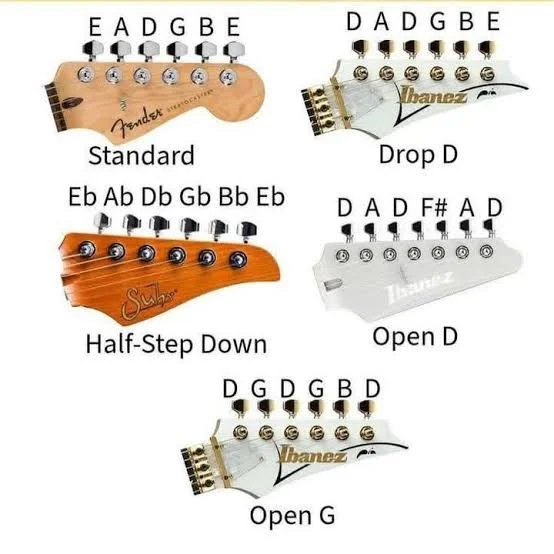
When learning to play the guitar, one of the simplest tasks is also one of the most important. Without a properly tuned guitar, it is impossible to play the correct chords, collaborate with other musicians, or even hold a tune. For this reason, learning to tune a guitar is one of the first things that new players should do.
A look at the basics
Electric guitars are tuned the same way as acoustic guitars. While the strings on electric guitars tend to be thinner than on steel-string acoustic guitars (and completely different than the nylon strings on classical acoustic guitars), the tuning process is exactly the same, as are the actual notes of each string. Guitar strings are typically tuned from top to bottom, with the top string being the thickest, the bottom string being the thinnest, and all of the strings in between having descending levels of thickness. The purpose of this is to allow the upper, thicker strings to support the lower notes with good resonance, while the thinner strings on the bottom of the neck are thinner in order to facilitate higher notes. As one might imagine, the notes on the strings ascend from lowest to highest when moving from the top to bottom strings.
The lowest string (known as the sixth string) is tuned at a low E, with the fifth string directly below it being tuned a few notes higher at A. Changing the pitch on a string is as simple as turning the peg that the string is attached to, either reducing the tension on the string (making the note lower) or increasing it (making the note higher). The fourth string is tuned to a D, with the third string being nearly a full octave higher than the fifth string at G. Finally, the second and first strings are tuned at B and high E, respectively, with the high E string being a full two octaves higher than the sixth string’s E. Hence, the standard tuning of a guitar is E, A, D, G, B, E. A convenient way to remember this tuning is with the phrase “(E)ddie (A)te (D)ynamite, (G)ood(B)ye (E)ddie.”
A guitar can be tuned to different pitches, but standard chord shapes remain usable only when the intervals between the strings stay the same as in standard tuning: E, A, D, G, B, E. If all the strings are raised or lowered by the same amount, the familiar chord shapes will produce chords in a different key. To match standard-tuned instruments or recordings, however, the guitar must be tuned accurately to standard pitch. Alternate tunings change the pitch relationships or overall range of the instrument.
Learning to tune a guitar
Thus, it is important to learn the pattern for tuning the fifth through first strings from the sixth string in standard tuning. The fifth fret of the sixth string matches the open fifth string; the fifth fret of the fifth string matches the open fourth string; the fifth fret of the fourth string matches the open third string; the fourth fret of the third string matches the open second string; and the fifth fret of the second string matches the open first string. Before using this method, the sixth string must be tuned to a reliable low E reference. This can be done with a tuner, pitch pipe, or accurately tuned instrument. A recording known to be in the key of E may not provide a reliable reference because it may use a different tuning or pitch standard.
Tuners allow a person to tune a guitar precisely and quickly. Tuning by ear is also possible with practice, although the process may take different amounts of time depending on the player’s experience. When using the sixth string as the reference for standard tuning, it should first be matched to the correct low E pitch before the other strings are adjusted. Alternatively, each string can be tuned separately with a chromatic tuner.Top of Form
Bottom of Form
Some guitarists enjoy using alternative tunings, which facilitate a number of distinctive playing styles. Hawaiian music is known for its use of slack-key guitar, or ki ho‘alu. The term refers to various tunings in which some or all of the strings are loosened from standard pitch, often creating an open major, major-seventh, dominant-seventh, or sixth chord. These tunings allow guitarists to fingerpick melodies, chords, and bass lines, with the thumb often playing the lower strings while the other fingers play the higher strings. The fretting hand may still be used for melodies, passing notes, and additional chords. Different slack-key tunings create different open-chord sounds and musical possibilities.
Drop tuning
Drop tuning generally involves lowering the lowest string relative to the others. In Drop D, only the sixth string is lowered from E to D, producing D, A, D, G, B, E rather than standard tuning’s E, A, D, G, B, E. The common form of Drop C is C, G, C, F, A, D: all six strings are lowered, with the lowest string lowered an additional whole step. Drop tunings extend the guitar’s low range, make power chords easier to play—often with one finger across the lowest three strings—and create different tonal effects. Although common in heavier genres such as metal, drop tunings can be used in any style of music.